A The ARC Atlas

Part Ⅱ · The interactive frontier NEW

ARC-AGI-3: don't solve the puzzle — learn the game.

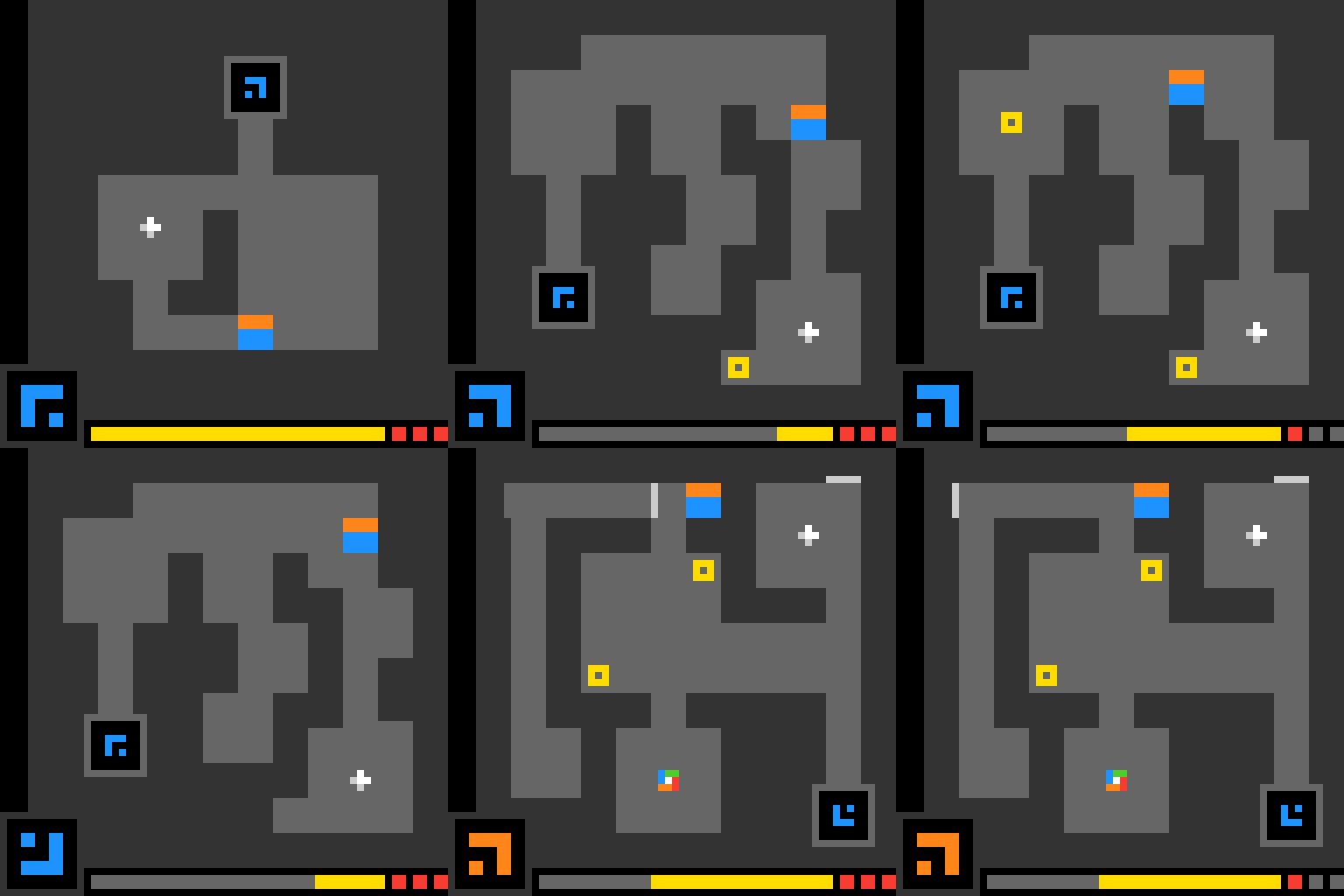
The first interactive benchmark in the ARC series (preview July–August 2025; paper 2026). No static grid to grade — an agent is dropped into an abstract, turn-based game with no instructions, no controls, and no stated goal, and must explore, build a world model, infer what winning is, and plan. It is barely a year old, and essentially unsolved.

100%
Humans solve
< 1%
Frontier AI (harness-free)
12.58%
Best preview agent
~135
Environments

What changed

Not a puzzle. A world.

ARC-AGI-1 and ARC-AGI-2 hand you a few input→output grids and ask for the rule. ARC-AGI-3 hands you nothing — just a screen and a few keys — and asks you to figure out the game by playing it.

Each turn the agent sees a 64×64 grid of 16 colors and submits one action from a tiny set (five keys + Undo + click-a-cell). The world is turn-based and never moves on its own, so the whole challenge is reasoning, not reflexes. Difficulty grows by composition of mechanics you had to discover for yourself. This is the first format change since 2019.

And it is scored on efficiency, not just success. RHAE (Relative Human Action Efficiency) = the human action count ÷ the agent's, capped at 1.15×, then squared to punish waste, level-weighted, and averaged over ~135 environments — a direct, first-contact human-vs-AI learning-efficiency comparison.

The direct literature

Papers about ARC-AGI-3 itself.

Only work directly defining or solving ARC-AGI-3 appears here. Broader ARC theory and adjacent methods stay in Part Ⅰ; competition implementations without papers stay in the solutions section below.

Category 1

Reference papers

The benchmark definition, task format, scoring, validation, and human baseline.

1 paper
№03 paper 2026

ARC-AGI-3: A New Challenge for Frontier Agentic Intelligence

Chollet et al. · arXiv · 2026

AgenticBenchmark

The first interactive ARC benchmark: an agent must explore a game with no instructions, scored on action efficiency vs humans — frontier AI scores <1%

Its job in the ARC-AGI-3 storyThe problem definition itself: the first interactive, instruction-free ARC benchmark, where an agent dropped into a novel turn-based game must explore, model dynamics, infer the goal, and plan across four pillars, scored by action efficiency relative to a human baseline (RHAE). It sets the frontier gap the whole shelf exists to close: humans solve 100% while frontier AI scores below 1%.

100%Human baseline
<1%Frontier AI (harness-free)
12.58%Best preview agent
~135Environments

Category 2

Solution papers

The smallest set of direct, technically substantive attempts to solve the interactive benchmark.

2 papers
№17 paper 2025

Graph-Based Exploration for ARC-AGI-3 Interactive Reasoning Tasks

Rudakov et al. · arXiv · 2025

Agentic

A training-free graph explorer that remembers every state it has visited beats LLM agents on ARC-AGI-3, taking 3rd place by out-acting them

Its job in the ARC-AGI-3 storyThe working ARC-AGI-3 agent on the shelf: a training-free explorer that keeps an explicit directed graph of hashed frame-states with salience-ranked action edges, reaching 3rd on the Preview Challenge private leaderboard. It is the proof-point that cheap deterministic exploration beats LLM agents (interaction-limited to ~4,000 usable steps vs. ~96,000 allowed) — while deliberately stopping at exploration and never inducing a model of the transitions it records.

3rd placeARC-AGI-3 Preview (private)
≈30/52Levels solved (median, 8h)
12 private levelsOfficial submission
~4k / 96k stepsInteraction budget used
S02 paper 2026

Hill-Climbing ARC-AGI-3

Fox, Wang, Rosu & Dhingra · ARC-AGI-3 academic partner paper · 2026

AgenticLLM harness

A Duke agentic harness gives Claude Opus 4.6 Python-based access to selectively retrieve and transform its long action history, solving all three public environments near human action counts.

Its job in the ARC-AGI-3 storyThe key LLM-harness solution paper in the repository's ARC-AGI-3 source material. It attacks the benchmark's context problem directly: instead of stuffing every 64×64 frame into a rolling prompt, the model can execute Python to query and compress its recorded history before acting. The result shows that scaffolding can produce near-human efficiency on seen public environments, while its failure to transfer to unseen environments makes it an equally important warning about harness overfitting.

3/3Public environments
Opus 4.6Model evaluated
0.0%TR87 without harness
97.1%TR87 with harness

The standalone paper is cited by the official benchmark report but no separate URL is bundled in this repository.

What's been tried

Every solution so far.

The ARC-AGI-3 Preview Challenge ran July–August 2025 — so the whole field of "ARC-AGI-3 solvers" is a handful of systems, months old. Here they are, best first. The pattern is striking: the winners all search; none of them truly model.

1
StochasticGooseTufa LabsLearned policy ~12.58% · 1st, preview

Trains a CNN+RL model to predict which actions actually change the frame, then runs informed search over the tiny action space guided by those predictions.

Why it worksLearning which actions are state-changing focuses search far better than random play or per-step LLM control, taking the top ARC-AGI-3 Preview competition score.

Where it stopsIt searches the action space rather than building a genuine predictive world model, so it never infers dynamics or the hidden goal.

2
Blind SquirrelExploration · state graph ~6.71% · 2nd, preview

Builds a directed state graph from observed frames and searches over it to cover the environment systematically.

Why it worksAn explicit graph of observed states remembers where it has been and drives methodical coverage, reaching 2nd in the preview competition.

Where it stopsRoughly half StochasticGoose's score; it is informed search over observed states, not modeling of the underlying dynamics.

3
Just-Explore (graph-based explorer)Rudakov, Shock & CowleyExploration · state graph 3rd, private preview · 12 official private levels (median ~30/52)

A training-free algorithmic explorer: a connected-component vision front-end with five salience tiers feeds a directed frame-hash state graph, over which a frontier-driven policy always heads toward the nearest untested action.

Why it worksBecause it never calls a model per step it spends the full ~96,000-step budget productively — where LLM agents stall around ~4,000 interactions — and beats LLM baselines to 3rd on the private leaderboard.

Where it stopsIt explores but never induces a rule for the transitions; state-space blowup caps hard levels, and a reset-marking bug depressed its official score below its demonstrated median.

4
Duke LRM harnessDuke UniversityLLM + harness all 3 public envs, ~human action counts · no transfer

A harness around a large reasoning model that executes Python to selectively retrieve and transform the recorded action history before each decision.

Why it worksTreating interaction history as a queryable, compressible database beats a naive rolling context window and reaches human-comparable efficiency on the public environments.

Where it stopsThe gains are on seen public environments only and do not transfer to unseen private ones — seen-environment performance is explicitly not AGI progress.

5
AregenticaSymbolicaLLM + harness all 3 public envs, ~human action counts · no transfer

An orchestrator-plus-subagent harness that decomposes play across coordinated LLM roles.

Why it worksThe orchestrator/subagent decomposition solves all three public environments at roughly human action counts.

Where it stopsLike all hand-built harnesses it overfits seen environments — bimodality as extreme as 0% harness-free vs ~97% hand-built on one env — and fails to generalize to private ones.

6
Frontier LLMs (harness-free)major frontier labsLLM agent ~0.1–0.5% (0.5/0.4/0.2/0.1) · <1% floor

The strongest general-purpose models served behind their own APIs, driven only by a fixed tool-free system prompt ('you are playing a game; reply with the exact action'), with no ARC-specific scaffolding.

Why it worksThis is the honest developer-aware-generalization baseline the official leaderboard reports — no per-environment engineering hiding the model's true ability.

Where it stopsIt sits at the sub-1% floor versus 100% human, failing at exploration, hypothesis revision, goal inference, and efficient planning under uncertainty.

The solution space

Everyone searches. No one models.

Map the approaches and the gap becomes obvious. Every deployed agent covers the state space by exploring it; none yet induces a reusable model of the dynamics and infers the goal — the two capabilities the benchmark was built to demand.

Dominant today

Graph-based state exploration (training-free algorithmic search)

A training-free explorer keeps a directed graph of hashed frame-states with tried-action edges, driven by a frontier-coverage policy (untested-local action -> shortest-path to nearest untested state -> relax salience threshold). A connected-component vision front-end with status-bar masking and five visual-salience tiers tames the 64x64 = 4,096-cell click space. It records transitions but never induces a rule for them.

e.g. Rudakov et al. training-free graph explorer (3rd, Preview Challenge); 'Blind Squirrel' directed state graph (2nd, ~6.71%)

Tried

Neural action-effect / RL exploration

A trained CNN+RL model predicts which actions actually change the frame and steers exploration toward state-changing moves. It is still informed search over the action space rather than a reusable model of the dynamics or the goal.

e.g. 'StochasticGoose' (Tufa Labs), 1st in the Jul-Aug 2025 Preview Challenge at ~12.58%

Tried

Frontier LLM as per-step controller (harness-free)

A general-purpose model behind its own API picks exactly one action per turn from a fixed tool-free prompt ('you are playing a game, reply with the action'), with no ARC-specific scaffolding. This is the official evaluation mode and the current floor; it is interaction-limited to ~4,000 of the ~96,000 allowed steps because every step is gated by a model call.

e.g. Official semi-private harness-free leaderboard: strongest frontier labs at ~0.5% / 0.4% / 0.2% / 0.1%

Tried

LLM + hand-built harness / scaffolding

Wrap a frontier model in per-environment scaffolding: execute Python to selectively retrieve and compress action history, or an orchestrator-subagent design. It solves all three public environments at roughly human-comparable action counts, but overfits to seen environments and does not transfer to the private sets.

e.g. Duke University LRM harness; Symbolica 'Aregentica' orchestrator-subagent (both solved all 3 public envs; 0% harness-free vs ~97% hand-built on one env)

Open gap

World-model program synthesis + planning (the main gap)

Induce an explicit program next_frame = f(frame, action) from recorded interaction traces, fit it incrementally, accept it only when it exactly replays every observed transition, then plan lookahead inside it with a verifier-in-the-loop that rejects the model on the first mispredicted transition. This is the Modeling pillar operationalized as verifiable code and is essentially untried on ARC-AGI-3.

e.g. No deployed ARC-AGI-3 system yet; closest analogues are the 2025 'refinement loop' (evolutionary program synthesis, propose->verify->iterate) and this repo's record->synthesize->replay-verify pipeline

Open gap

Goal / reward induction from delayed feedback

Infer 'what winning means' with no instructions: a hypothesis search over candidate reward functions or desirable states, driven by intrinsic motivation / empowerment and revised from sparse, delayed terminal (win-frame) feedback. Today's agents instead piggyback on the environment's level-completion signal rather than inferring the goal.

e.g. None deployed; the Goal-Setting pillar and the 'learned goal inference from delayed reward' direction (intrinsic motivation + hypothesis maintenance over candidate goals)

The tradeoffs that shape it

Interaction budget vs per-step cost
cheap deterministic acting (~96,000 steps) expensive per-step LLM reasoning (~4,000 steps)

Every LLM step is gated by a model call, so LLM agents starve at ~4k of the ~96k allowed steps while cheap algorithmic explorers spend the whole budget productively -- the interaction-limit that lets simple search beat LLMs today.

Harness-free generalization vs hand-built scaffolding
harness-free general model (official leaderboard) hand-built per-environment harness (community leaderboard)

Hand-built harnesses reach ~97% on a seen environment but 0% harness-free and do not transfer to private envs, so seen-environment performance is not progress -- the harness-overfitting problem.

Search/explore vs model-and-infer-goal
record and search transitions (coverage of the state space) induce a reusable dynamics model and infer the goal

The crucial gap: every current top agent does informed search/exploration over actions; none builds a reusable model of the dynamics or infers the goal, and pure coverage plateaus on state-space blowup (e.g. ls20 L3+, ft09 L6+).

Where the frontier actually is

The frontier is defined by one stark fact and one crucial observation. The fact: humans solve 100% of environments while frontier AI scores below 1% (harness-free official scores of ~0.1-0.5%). The observation: every agent that actually works does informed SEARCH / EXPLORATION over the action space, not genuine world-MODELING or goal-inference. In the Jul-Aug 2025 Preview Challenge the top three all shared this shape -- 'StochasticGoose' (CNN+RL predicting which actions change the frame) at ~12.58%, 'Blind Squirrel' (a directed state graph built from observed frames) at ~6.71%, and Rudakov et al.'s training-free graph explorer in 3rd. As that paper puts it, the agent 'explores but never models': it records a directed graph of (state, action) -> next_state transitions but never induces a compact rule that explains them, and it never infers the goal -- it piggybacks on the environment's level-completion signal. Two of the four pillars (Modeling, Goal-Setting) are essentially unattempted by the systems that lead the board.

Two structural constraints explain why search dominates -- and why it plateaus. First, the interaction limit: because every step of an LLM agent is gated by a model call, it manages only ~4,000 usable interactions against the ~96,000 the environment allows, so a cheap deterministic explorer wins simply by spending the entire budget without forgetting where it has been. This is the argument for using cheap acting to gather data and reserving expensive computation for offline model-building. Second, the harness-overfitting problem: hand-built harnesses (the Duke LRM harness, Symbolica's 'Aregentica') solve all three public environments at human-comparable action counts, but the same environment can go from 0% harness-free to ~97% with a hand-built harness, and none of it transfers to the private sets -- which is exactly why the official leaderboard reports only harness-free general systems. Pure coverage-search then hits its own ceiling: exploration cost grows linearly with the reachable state space, so it degrades sharply where the graph explodes (ls20 L3+, ft09 L6+) and where goals require compositional/relational understanding rather than reaching a specific hashed state.

The main open gap is world-model synthesis + planning, paired with goal induction -- the Modeling and Goal-Setting pillars that no deployed agent yet attempts. The concrete direction is to turn the recorded transition graph into training data for an explicit program next_frame = f(frame, action), fit incrementally from a few dozen actions (active learning / optimal experiment design over which action to try next, since scoring caps actions at 5x human via RHAE), accept the program only when it exactly replays every recorded transition, and then plan lookahead inside it -- with a verifier-in-the-loop that rejects the model the moment a predicted transition disagrees with reality. In parallel, goal/reward induction must supply the feedback signal the 2025 'refinement loop' lost when it left static demonstration pairs behind: forming and revising hypotheses about desirable states from sparse, delayed win-frame feedback, aided by intrinsic-motivation / empowerment objectives. ARC-AGI-3's determinism, small action space, and turn-based frames make such exact, verifiable models tractable -- this record -> synthesize -> replay-verify -> plan loop is precisely the north-star this repo is built around, and precisely what the current search-only frontier is missing.

The open questions

What to answer next.

The highest-leverage unanswered questions for ARC-AGI-3, ranked. The marks the ones that turn directly on synthesizing a world-model program and accepting it only when it exactly replays every recorded transition — the bet of the arc_agi_ideation project this atlas accompanies.

  1. 1

    Can a reusable world model be formed from a few dozen actions?

    North-star #1 and the direct target of the record→synthesize→replay-verify loop: humans infer an environment's dynamics in a few dozen actions while frontier AI scores <1%, so the open question is what learning procedure fits an accurate, reusable next_frame=f(frame,action) program that fast — under a scoring regime that caps actions at 5× the human baseline and rewards first-contact efficiency (active/optimal-experiment-design over which action to try next, not millions of rollouts).

  2. 2

    How do you infer the goal with no instructions and no reward until the win frame?

    The Goal-Setting pillar has no ground-truth signal until the terminal win frame, so the agent must propose and revise hypotheses about which state is desirable from sparse, delayed feedback where early exploration looks indistinguishable from progress — the source names goal/reward induction the capability that most separates humans (100%) from frontier AI (<1%). Marked non-core because it targets the reward/goal, a distinct pillar from the transition-dynamics program that replay-verification actually certifies.

  3. 3

    Does an exactly-replaying synthesized program generalize to unseen states?

    A program accepted because it replays every recorded transition may still be wrong on unseen states — the ARC generalization problem one level up, at the level of dynamics rather than input→output — so the repo's whole verifiability bet stands or falls on whether exact-replay acceptance empirically predicts held-out generalization. Answering it tells us whether the acceptance gate is a proxy for correctness or just for memorization of observed transitions.

  4. 4

    What replaces the missing execution oracle for the refinement loop?

    The 2025 refinement loop (propose→verify→feedback→iterate) depended on an exact-match-on-demonstration-pairs oracle that ARC-AGI-3 removes because the goal is hidden and must be probed; the repo's candidate replacement is reward from exact replay of gathered transitions, and validating that this signal is rich enough to drive incremental program synthesis/repair is central to the pipeline. Without it there is nothing to make the loop converge.

  5. 5

    What is the right compressed, queryable representation of interaction history?

    64×64×16-color frames accumulate fast and a naive rolling window exhausts a model's context, making history management a first-order bottleneck — the strongest observed results came from harnesses that selectively retrieve and compress the action history (treating it as a queryable database), and cheap graph-explorers use ~96,000 allowed steps where LLM agents are interaction-limited to ~4,000 model-gated ones. The open question is which learned summaries preserve planning-relevant state.

  6. 6

    How do you attribute the <1% across exploration, modeling, goal, and planning?

    The single RHAE scalar cannot say whether frontier agents fail primarily at exploration, world-model formation, goal inference, or planning, so a diagnostic that isolates each pillar (e.g. an auxiliary next-frame-prediction probe scoring modeling independent of task success) is needed to know which subproblem to attack first. Without this decomposition, research effort is allocated blind.

  7. 7

    How do you measure genuine harness-free generalization instead of overfit scaffolding?

    Harnesses overfit to seen environments and do not transfer — the same environment can yield 0% harness-free versus ~97% with a hand-built harness, and academic harnesses that solved all three public environments failed on unseen private ones — so it is hard to distinguish "the agent reasoned" from "the harness encoded the answer." This is a direct caution that the repo's value must live in a general record→synthesize→replay-verify→plan pipeline, not per-environment scaffolding, and measuring that cheaply is unsolved.

  8. 8

    How do you separate rational exploration cost from wasteful brute force under RHAE?

    RHAE's squared penalty (h/a capped at 1.15×, then squared) punishes wasted actions, but good exploration necessarily spends actions to reduce uncertainty — so the open question is whether there is a principled decomposition of "exploration actions a rational agent must spend" versus "brute-force waste," and whether the human baseline already bakes that tradeoff in correctly. It matters because the metric is the only definition of intelligence the benchmark exposes.

3 of these turn on building and verifying a world model from interaction — record every transition, synthesize a program that predicts the next frame, and accept it only when it replays the history exactly. That is the thread from Part Ⅰ's whole program-synthesis lineage into the agentic frontier.

↩ Back to Part Ⅰ · The Atlas of 21 papers

Locally synthesized · no network

ARC Radio

01 / 08 Unknown Unknowns Exploratory circuitry in D Dorian: curious, bright, and never quite settled.

Eight original AI-composed retro-game loops. Audio is generated live in your browser; it keeps playing when you close this panel and stops only when you press Pause.

Field notes · reader review

Help improve this guide

This atlas is a living draft. Spotted a wrong score, a broken link, a paper we should add — or just have a thought on how it reads? Tell us. Every review steers the next revision.

How useful is it? optional
— / 5
What kind of note? optional

No account, no tracking. Sent straight to the maintainer.